
The UNI mystery of the Campanile's "World Grand Prize"
The UNI mystery of the Campanile's "World Grand Prize"
Nearly 100 years ago, the Campanile first rose over what is now the University of Northern Iowa campus. But what if we told you one of its most fascinating pieces was already more than 50 years old at the time?
While the Campanile wasn’t constructed until 1926, its original clock mechanism was already on display in 1876 — the same year the Iowa State Normal School was founded. Built states away from the Midwest, the remarkable mechanism eventually made its way to UNI, bringing with it a mystery that would go undiscovered for years.

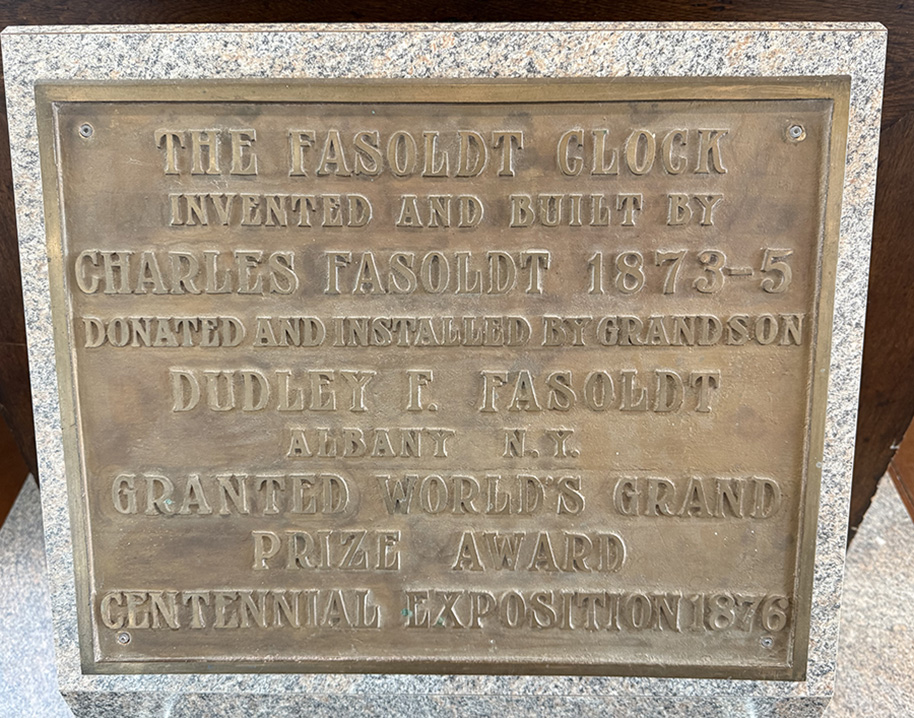
For decades, a bronze plaque on UNI’s Campanile claimed that the historic tower clock mechanism had won the “World’s Grand Prize” at the 1876 Centennial Exhibition in Philadelphia. There was just one problem… the prize had never existed.
The mystery of the plaque became a years-long investigation by Nathan Arndt, director and chief curator of the UNI Museum.
When Arndt first walked through the museum’s collection in 2014, he wasn’t expecting to stumble into a puzzle. Tucked away among years of stored artifacts was a massive metal cabinet unlike anything else in the museum, containing an oversized arrangement of iron and gears.
“It was a clock mechanism, and it was pretty obvious we knew what it was,” said Arndt. “It also had references to a plaque but nothing else.”
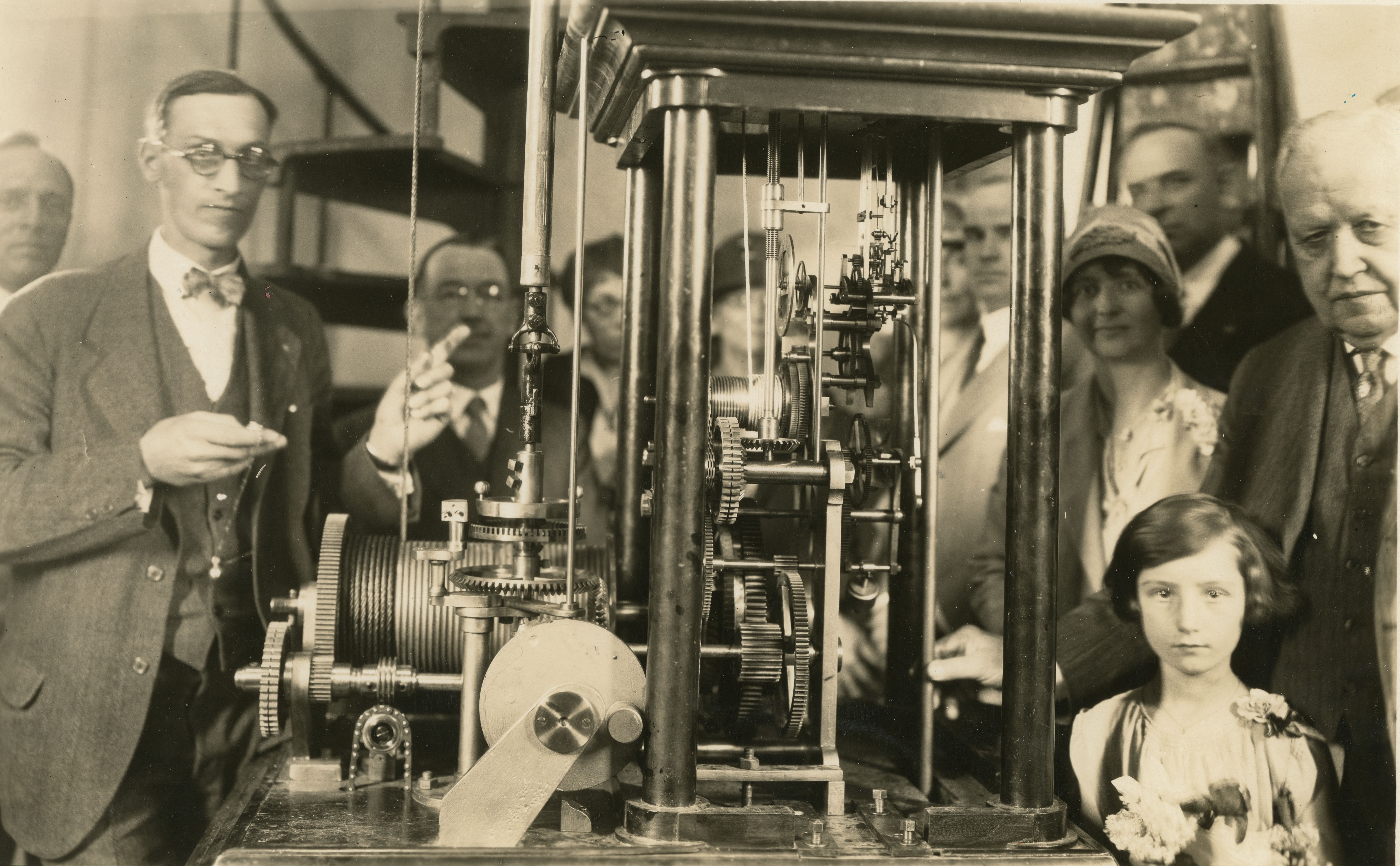
The mechanism was an extraordinary example of 19th-century engineering, crafted by Charles Fasoldt — one of the era’s most respected clockmakers — and had been preserved by a UNI graduate who ensured it would survive for future generations.
“[Fasoldt] was a world-renowned maker of clockworks,” said Arndt. “This is quite a collectible piece.”
That discovery launched a treasure hunt through the museum’s collection, as Arndt searched for the missing pieces of the historic machine and tried to reconstruct its journey to UNI.
He first discovered wooden poles used to support the mechanism. Then came one of the most unusual finds: a 50-pound cylinder of mercury, once used to power the clock – now under special care and preservation.
Also among the artifacts was the bronze plaque that had once been mounted on UNI’s Campanile, but the museum had no documentation explaining its origin.
“We have nothing on this plaque,” said Arndt. “We know nothing about how it came off of the Campanile or how it ended up at the museum.”
As Arndt continued researching the clock, he discovered the original certificate that accompanied the mechanism. What it said, however, didn’t match the wording engraved on the Campanile plaque.
The plaque claimed Fasoldt had won the “World’s Grand Prize,” but Arndt couldn’t find any historical record proving the award existed.
Arndt continued digging, and while working with The Library Company in Philadelphia in 2025, he traced records from the 1876 Centennial Exhibition – the same year the Iowa State Normal School was founded.
“The Philadelphia Centennial Exhibition has an archive that’s managed, so I reached out to them, and they pulled up all the original records and everything from it,” he said. “They were like, ‘well, first of all, that wasn’t a real prize at the Exhibition, but he did win the general prize.’"
The findings confirmed what Arndt had suspected all along.

Fasoldt had indeed been recognized at the 1876 Centennial Exhibition in Philadelphia, receiving an award for his astronomical tower clock. But there was no evidence he had ever received the “World’s Grand Prize” described on the plaque.
“Let me make this one thing clear,” said Arndt. “The clock mechanism is amazing, and it is a very cool piece. But it just didn’t win the World’s Grand Prize award.”
As Arndt pieced together the mystery of the plaque, he also discovered the clock’s voyage to UNI.
In 1925, former UNI faculty member James Owen Pierrine visited Fasoldt in New York and convinced the company that the historic clock would be highly valued and respected at the Iowa State Teachers College, partly due to shared 1876 creation dates and the vision and leadership of President Seerley. Pierrine eventually persuaded them to donate it to the university despite already having piles of requests. Fasoldt’s son Dudley personally escorted the massive mechanism by train to campus.
Although the mechanism was innovative for its time, the clock wasn’t perfect. It struggled with accuracy and ultimately served the Campanile for 30 years before being retired to the UNI Museum.
And for Arndt, the greatest discovery wasn’t finding forgotten pieces of a historic machine — it was proving that history is never finished.
To see the clock mechanism and its plaque yourself, you can find it just inside the northwest doors of Maucker Union, closest to Rod Library.
In honor of the Campanile’s 100th birthday, the UNI Museum will host a special digital 3D exhibit. Learn about what’s in store.