

Ethics for Professional Life
Ethics for Professional Life
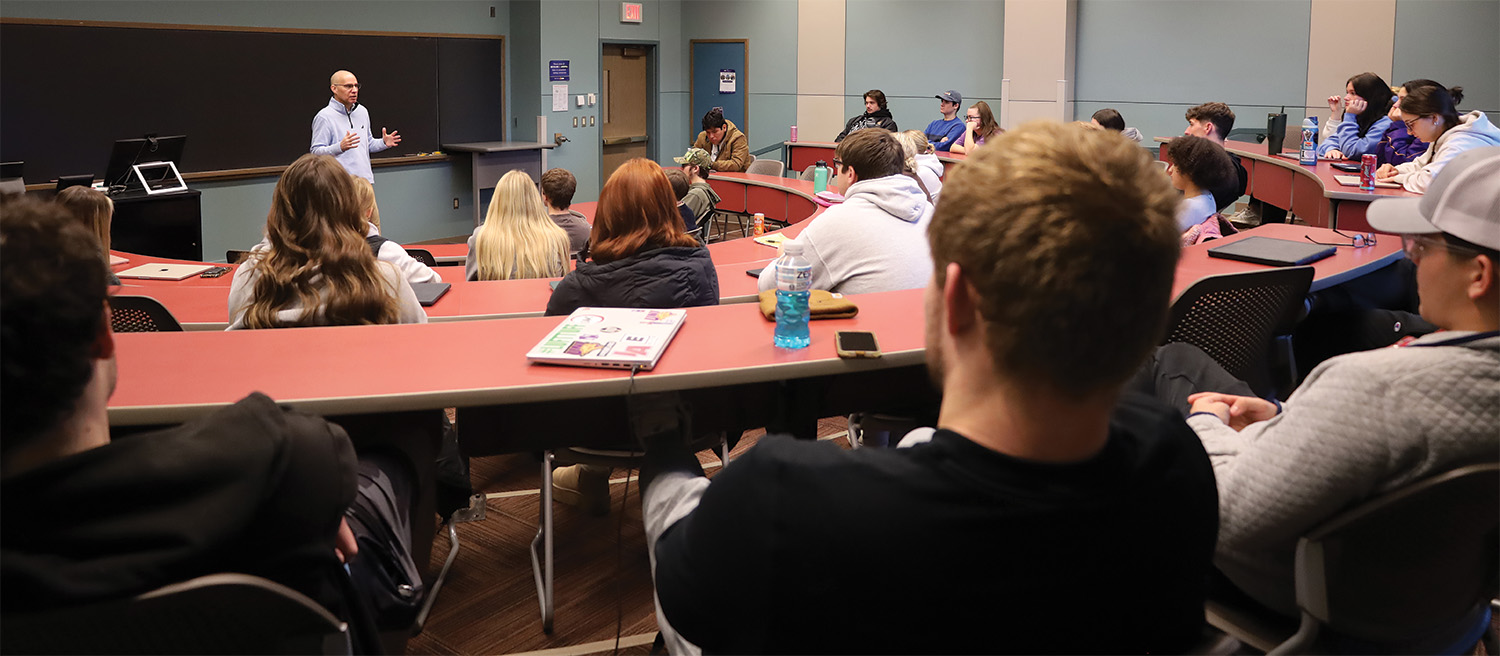
The Wilson Endowment for Integrity and Excellence is fueling a campus-wide expansion of ethics education, elevating the Wilson College of Business and creating new opportunities for students across disciplines. With new courses, faculty collaborations and expanded opportunities for students, ethics education is becoming a deeper and more visible part of the UNI experience.
At UNI, preparing students for successful careers goes beyond technical knowledge and professional skill; it also means equipping them to navigate complex decisions with clarity and integrity. That emphasis is central to Ethics for Professional Life, a new course offered by the Department of Philosophy & World Religions and developed by Professor Nicholas Sars, a Wilson Ethics Fellow.
The course introduces students to applied ethics through the lens of responsibility — personal, civic and professional. Its reach is broad, drawing students from engineering, business, education, healthcare, pre-law, the arts and more.
“We all juggle all of these different realms in our lives all the time,” Sars explained. “Each of them has a different set of norms, a different set of expectations. And we do this so naturally that we don’t really think about it.”
Negotiating those overlapping domains can lead to conflict. Through the course, students engage ethical theories, examine competing values and strengthen the critical thinking skills needed to navigate complex situations.
“Often in life there isn’t going to be a set of professional rules to help you through difficult situations,” Sars said. “You will have to use your best critical judgment in the moment, weighing the different values involved — and act.”
Growing Student Demand
Since launching in 2024, Ethics for Professional Life has gained significant momentum. In less than two years, the course has enrolled over 270 students.
This fall, John Preston, ’12, assistant adjunct professor, offered his own section. The first half of his course introduces students to foundational ethical philosophies from Aristotle, Immanuel Kant and John Stuart Mill. The second part of the semester shifts to applied ethics in business, medicine and technology, supported by guest speakers such as local professionals who discuss ethical leadership.
The goal, Preston said, is for students to develop habits of ethical reflection.
“I tell my students: I’m not going to claim to give you the ‘right’ answer or the ‘correct’ theory,” Preston explained. “I want my students to internalize the importance of investigating their actions and to take away some skills in critically analyzing and understanding their own thought processes. That’s the value of studying philosophy.”
The prospect of a business course focused on ethics caught Jacob DeShazier’s attention. That was the first offering of Ethics for Professional Life in fall 2024, and the marketing and management major signed up right away.
“As someone who plans on one day working in the corporate world, I wanted to educate myself in order to make positive change at whatever company I end up at,” DeShazier said. He’s since added two minors: philosophy and ethics. Across campus, the ethics minor has become one of the fastest-growing minors, a popular complement to pre-professional degrees.
Jason Vinsick decided to pursue a philosophy major, complementing his business administration major, after taking Sars’ course.
“The lesson that stood out to me most was when we studied Tom Morris’ book, If Aristotle Ran General Motors,” Vinsick said. “Connecting those concepts alongside virtue ethics really changed the way I look at my day-to-day interactions. It made me more aware of the character and intention I bring into my relationships, and it genuinely influenced how I show up for people in my life.”
Wilson Gift Expanding Opportunities
Support from the Wilson Endowment for Integrity and Ethics has been essential to the growth of ethics at UNI, funding new course development and faculty collaboration.
“This amount of money being dedicated to ethics is entirely rare; it’s an incredible opportunity. And I think it’s perfectly timed. My students are craving ethics in their lives. They want the world to be more fair, to be helping more people. They want to feel good about the businesses they will be running in the future.”
Brooke Sumner, a biology major who plans to pursue a career in dentistry, said the course strengthened her critical thinking skills.
“I think every college should have ethics courses that are required, as they allow you to develop skills that other classes may not provide,” Sumner said.
Sars sees continued opportunities for ethics education at UNI. New courses are being explored, and partnerships with the Wilson College of Business are creating additional touchpoints for students across majors to engage with ethical questions.
“Every generation faces its own unique challenges,” Sars said. “But critical thinking, reflection and ethical leadership will serve this generation just as powerfully as they’ve served others. That’s what we’re helping students build: a foundation they can carry with them for the rest of their lives.”