
Continuing to adapt: Degree in 3
Continuing to adapt: Degree in 3
 Following an announcement of an accelerated pathway to a bachelor’s degree in elementary education — dubbed the Degree in 3 — about 15 students started at the University of Northern Iowa this fall expecting a successful, but shorter, stay in Cedar Falls.
They share a profile: incoming students who are willing to commit to the pace of a year-round program to complete their degree in three years, including student teaching.
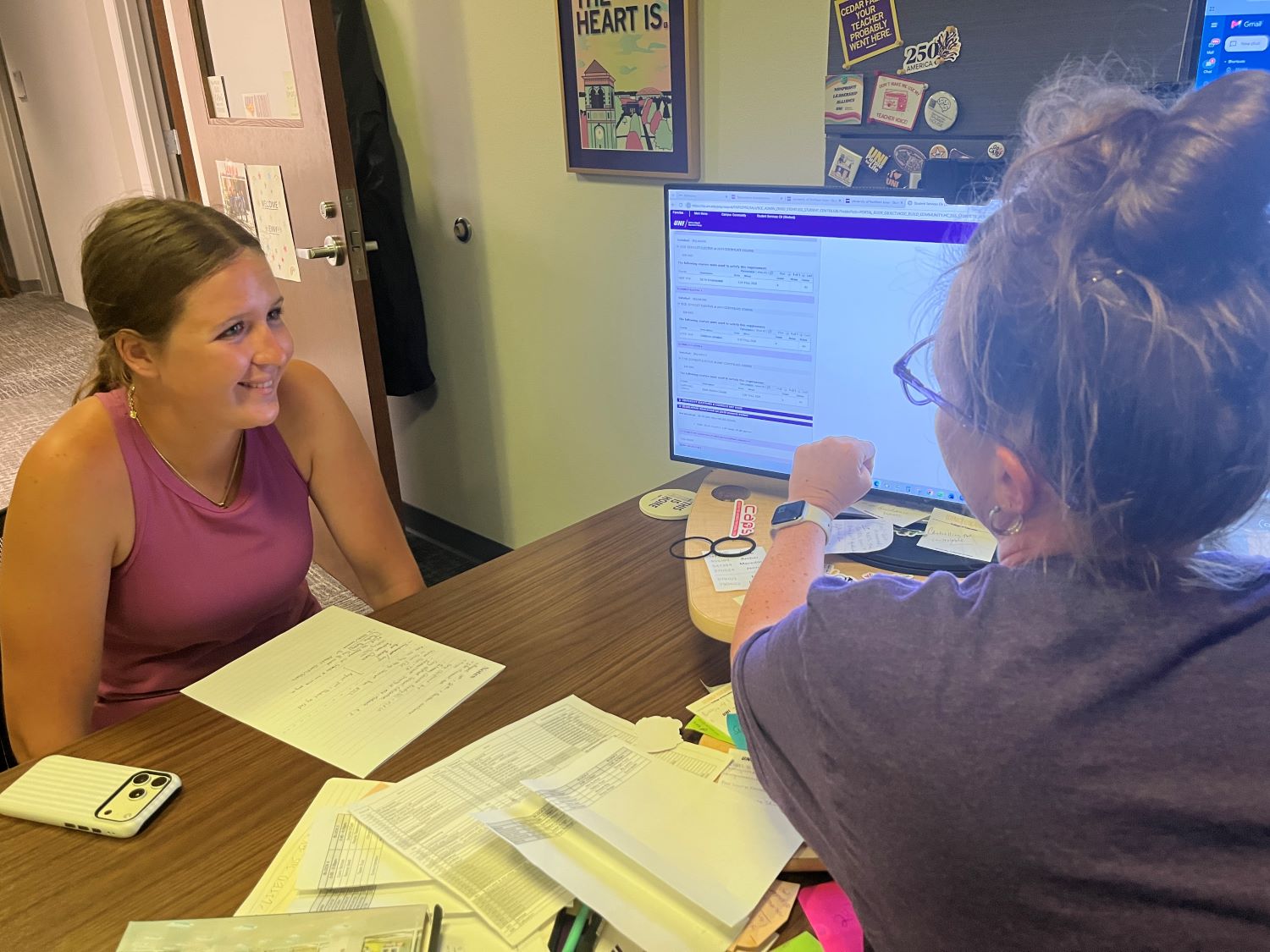
“Prospective students seem excited about a fast track,” says Jenny Connolly, director of advising for the College of Education. “Motivated, organized students who are committed to graduating as fast as possible ... that’s who we expect to find this program attractive.”
A faster pathway to elementary teaching
This option to complete a degree earlier, save money and begin teaching sooner offers future educators yet another pathway toward becoming an elementary educator. It joins the traditional on-campus BA for incoming freshmen and transfer students and the Online Transfer Program and Purple Pathway for Paraeducators for placebound students.
The new pathway maintains the standard curriculum of 120 credit hours for completion and the same expectations for clinical experiences in K-6 settings. Students will complete coursework year-round, including winter and summer sessions (as needed), followed by student teaching. Graduates will also qualify for Iowa’s K-8 literacy endorsement in reading. They could lead their first classrooms as soon as fall 2029.
Upon announcing the new pathway — UNI’s first, formally designated undergraduate accelerated program — plenty of questions arose. Is this for freshmen only? Can you bring in college credit? What’s different from the increasing percentage of students who enter UNI today with college credit already in hand — and finish earlier already?
Among the answers: the program, at its core, was built to ensure it could accommodate incoming freshmen with few or no existing college credits, says Robin Dada, head, Elementary and Middle Level Education. But flexibility remains.
“As the state’s largest program in elementary education, our goal is to continue to offer options that meet student interests as well as workforce needs. This is a specific year-round program, with the curriculum built accordingly. At its very core, we wanted to make that work,” she notes.
As profiles change, programs adapt
The variety of programming in elementary education reflects changing student profiles across the college and university. The College of Education Advising and Teacher Education Success team tracks trends, including:
COE majors at-a-glance:
- Nearly 80% of incoming freshmen transfer in an
average of 21 hours of credit - 40% are transfer students (higher than the UNI
norm) - Today’s students are more focused on their
budgets, time and careers. - Residential students still prefer in-person courses,
while the number of students in online degree
options continues to increase
- Adult learners are a greater mix of younger and
older adult students - As criteria change, including the inclusion of
elementary education within degrees that meet
qualification, more are qualifying for TEACH grants:
760 in 2024-25, up from 366 in 2020-21 - Over 1,100 undergrad majors result in 3,000+
advisor appointments annually
One new option among several
Connolly says the actual fit for the program is very individual. As advisors worked with both prospective students and current freshmen considering switching to Degree in 3, variables including commitment to a three-year pathway, existing credits and comfort with the year-round curriculum were part of the dialogue.
Degree in 3 for elementary education is an on-campus, residential program. In spring 2026, about 600, or 70%, of the more than 800 elementary education majors were students on campus. For the College of Education in general, about 40% are transfer students, including online and on-campus students. About 79% come in with some type of college equivalency credit.
With such a diverse mix of elementary education majors, advisors work with students and their individual circumstances to craft a road to degree completion that may end up taking more or less than four years, depending on majors and minors, credit status — and the type of experience students seek while on campus.
“What the Degree in 3 offers is a plan of study that motivated students can count on from day one,” Connolly says. “It may not be for everyone, but we’re here for students who seek this option.”
It has its incentives, including tuition support for summer sessions, a student teaching stipend to offset living expenses and dedicated advising, academic, career and wellness support.
The final attraction: starting a teaching career a year earlier. “The combination of less time on campus and added financial opportunities puts students an estimated $70,000 ahead in contrast to a traditional four-year path,” notes Dean Colleen Mulholland.
Planning for success
 Creating this additional version of a curricular schedule required collaboration and campuswide conversations, particularly in working through what the summer experience and coursework will look like.
“The College of Education has developed capacity in seeing varied opportunities for completion through the work with the Online Transfer Program and Purple Pathway for Paraeducators. Neither are the same as the Degree in 3, but our flexible thinking helped to identify courses that might best fit in summer vs. the long semesters,” Dada says.
Current plans call for an eight-week, on-campus summer session; a winter break option will be offered as needed.
As with adjustments that happen along the way for many students, those enrolling in Degree in 3 have the flexibility to move into the “traditional” four-year degree at any time, Connolly says.
“All of our students are on their own path. With our multiple pathways, we do our best to support who students are and where they are, whether they’re placebound or campus-based, freshmen or transfer students,” she adds. “Degree in 3 gives yet another choice, something that benefits our students as well as prospective employers and communities our graduates serve.”